
The market failures behind bad outsourcing outcomes, and what buyers can do about it.
When I first started hiring external teams as an independent studio, I'd ask every service provider the same naive question: "Do you have availability for this project?"
Guess how many said they were fully booked?
None.
Instead, I'd hear some version of the following answer 95% of the time: "We have a team that's a perfect fit for this. They're just rolling off another project and will be available right around when yours kicks off."
Convenient, right? Almost too convenient. After hearing this enough times, I started to wonder: if everyone's always conveniently available, what does "availability" actually mean?
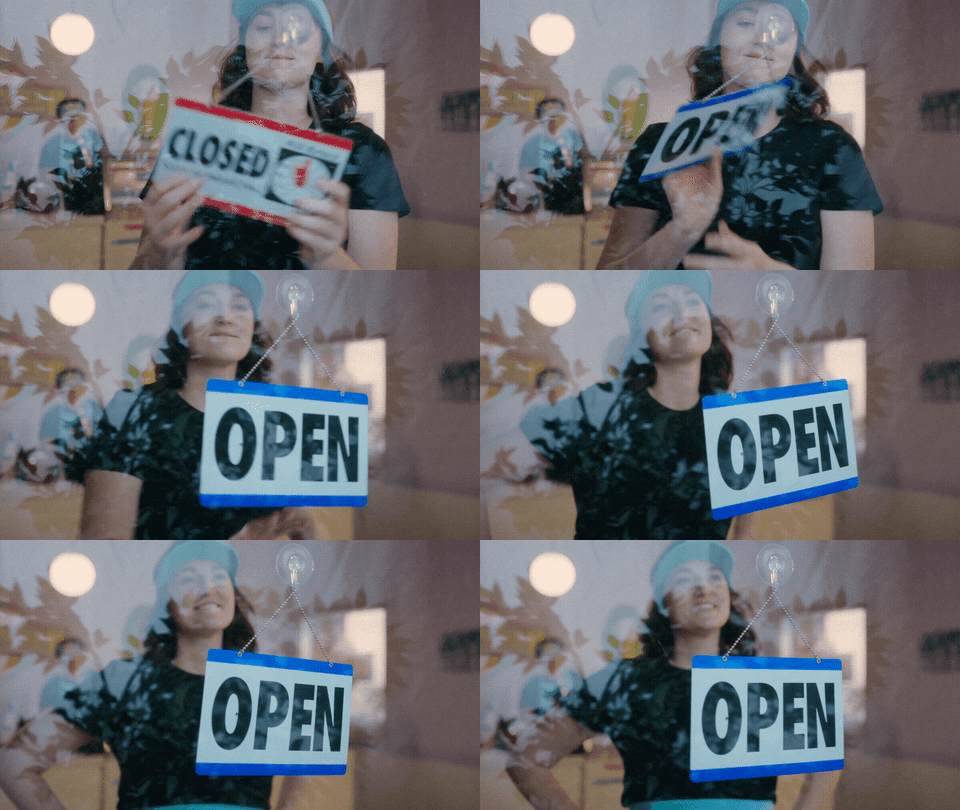
Here's why it matters: for a service studio, idle capacity is a cost sink. Every unassigned salaried employee is adding to their burn rate. The moment that person becomes billable, margins jump and risk drops. This means availability directly affects price, attention, and quality. When a team has openings, senior staff get involved and pricing is flexible. When they're fully utilized, you're competing internally for attention.
Why Every Studio Says the Same Thing
So if availability matters this much, why don’t studios just tell you the truth about their capacity?
Because the market punishes honesty.
Saying "not busy" signals weak demand. Saying "fully booked" closes the door on upside. So the rational response becomes: "Busy, but conveniently available."
And once most studios adopt the same message, any studio that deviates is worse off. The honest studio saying "we're genuinely not busy" just looks desperate. Honesty gets competed out of the market.
The result is what economists call a pooling equilibrium: everyone says the same thing regardless of reality. Studios with genuine slack and studios at full capacity both claim to be "conveniently available." Buyers can't separate the two, so the signal stops carrying information.
Fragmented Markets Fail Buyers
From a game theory perspective, availability statements are textbook cheap talk: costless to send, unverifiable when stated, penalty-free when exaggerated.
But this isn't just about availability. It's about how fragmented markets break honest signaling.
The structural problem is asymmetry. You’re looking for a long-term partner. They're evaluating a pipeline of opportunities. You might not go to the market again for years, so whatever they tell you now, you almost certainly won't be back to hold them accountable.
That's a one-shot game. And in one-shot games, short-term incentives dominate. That creates predictable failures well beyond availability signaling.
To be clear: not every studio behaves this way. AAA publishers with large portfolios have an easier time. They're repeat buyers with long memories, so reputation actually matters. And plenty of honest studios resist these pressures . But the dynamics exist in the market structure itself, which means they show up often enough to matter. Understanding them helps you design processes that surface the good actors and filter out the rest.
Here's what to watch for:
Moral Hazard
Moral hazard is what happens when incentives change after an agreement is made. The deal you signed isn't the deal you're living with anymore.
In external development, there's a specific moment when leverage flips: the first payment. Before that, the studio is competing for your business. After that, you're no longer shopping. You're trapped in execution. Switching costs are brutal: lost time, sunk cost, internal embarrassment, publisher pressure. Studios know this.
Under these conditions, optimizing for deal win rate instead of delivery quality becomes rational. The playbook: underbid aggressively, move fast to contract, then surface "unforeseen complexity" once you're committed. Change orders begin. Timelines stretch. Budgets expand.
We've seen this countless times. A buyer once showed me a quote they received for a full game project. The well-known service studio had received a three-sentence description, with the buyer referencing a popular AAA title, saying they wanted something similar. The quote? Five figures… to build something comparable to a game that cost tens of millions. The studio didn't ask clarifying questions or push back on scope. They saw an unsophisticated buyer and priced to win.

I've also had this happen to me directly. Early in my outsourcing career, another “highly rated” service studio I was referred to doubled the project price at the first milestone. When I asked them to explain the change, they had reasons… but none that held up. I pulled out the production schedule from the original proposal and walked through it line by line. Neither of us could identify a single delta to support the increase. We fired them immediately, but not before burning four months and a milestone payment.
Some studios do this intentionally - our definition of Bad Actors (yes they exist, and yes we keep a list). Others come by it more innocently: victims of their own sales teams overselling. But from the buyer's perspective, the distinction doesn't matter. The outcome is the same.
Signaling Arms Race
When honest signals stop working, what fills the void? Discoverability.
Turns out studios that optimize for winning deals also get very good at being found. SEO, AI-optimized content, aggressive outbound, polished portfolios. Marketing becomes the core competency, not delivery.
Those Bad Actors we keep a list of? They're incredibly good at this. Their names pop up constantly. Not just in Google searches or AI queries, but even in our own process. Searching for best fit studios takes an enormous amount of time, so at CDR we distribute the work across a research team and review anything junior members surface before presenting a shortlist to clients. And without fail, new team members keep surfacing the same problematic names.
Discovery skill gets mistaken for delivery skill. The most polished, visible studio wins the bid. Whether they're the best delivery partner is a separate question entirely.

Adverse Selection
Adverse Selection happens when the process of selection itself skews the pool of participants in ways the selector doesn't want.
Here's how it plays in external development: strong studios with healthy pipelines and good reputations have options. They can afford to be selective about which RFPs they respond to. If your process looks noisy, time-consuming, or unlikely to close, they might pass entirely. Or they'll submit a defensive bid, pricing high enough that they're happy to win, but not unhappy to lose.
Meanwhile, studios willing to say whatever it takes to win will invest heavily in every opportunity. They'll respond to everything, promise the moon, and bid aggressively.
The result: the market skews toward whoever is most willing to underbid. You send an RFP to five studios. They all estimate the work. One comes back 40% cheaper than the others. Amazing, right?

Maybe. Or maybe they missed something. Maybe they're underestimating scope, overestimating their team's speed, or assuming requirements won't change. Or worse, they’re counting on requirements to change so they can charge for it later. Some studios build that buffer into their bid. Others treat change orders as a profit center.
Nearly everyone in external development learns this lesson early in their career. You take the low bid. Deadlines slip. Change orders stack. Extensions get negotiated. And before you know it, you've wasted more time and money than if you'd taken the higher, more reputable bid in the first place. Sometimes the project still fails anyway.
We've seen clients pass on what we felt were ideal candidates because they took a flyer on a studio promising something that simply doesn't pencil. The team size, the timeline, the budget…the numbers just didn't add up. But, they promised what the client wanted to hear. And that was enough to win the deal.
And guess what happened? Surprise, the project didn't deliver. It got canceled once the budget ran out and everyone walked away with nothing. Meanwhile, the studio that stayed strong, didn't cave to pressure, and told the honest truth lost the deal.
But placing all the blame on buyers isn't fair either. Often, the problems are upstream of the person making the decision. They're being asked to do something with not enough budget. Or not enough time. And they're faced with a choice: deal with the hard truths, or hope for a miracle.
It's just that, in our experience, miracles tend to turn into much harder truths six months down the road.
What Buyers Should Do Instead
Understanding these structural dynamics allows you to design processes that reward honest behavior and surface studios that actually deliver.
Run a competitive process. You can't evaluate a bid in isolation. You need to see how it compares to alternatives. Even if you have a preferred partner, get other bids. The information is worth the effort.
Pull pricing early. Without market context, you can't tell a fair price from a scarcity price. You can't tell real demand from signaling. You anchor blindly. This is exactly where buyers get trapped.
Surface uncertainty early. Don't let studios hide what they don't know. Ask explicitly: what's unclear in this brief? What assumptions are you making? Where does your estimate have the most risk? Make it safe to admit uncertainty by rewarding it in the evaluation.
Start small. Talk is cheap, but delivery reveals truth. If you can structure the engagement so the first milestone is narrow and meaningful, you can learn more in four weeks of real work than in four months of evaluation.
Ask questions that force tradeoffs. Not "can you do this?" but "what would you cut if the budget dropped 20%?" Not "is your team senior?" but "what will the most junior person on this project be responsible for?" Questions that require choosing are harder to spin.
Watch for consistency. Do claims stay stable over time? Does the person you talked to in week one say the same things as the person in week four? Inconsistency is a red flag, either of misalignment or flexibility with the truth.
Building a Better Market
The core problem is structural. One-shot games create bad incentives. Reputation doesn't flow. Signals break down. Buyers are disadvantaged because they lack the context to evaluate what they're hearing.
The way most people in games avoid these problems today is to work exclusively through referrals. And referrals aren't bad. But with thousands of studios available in games today, limiting yourself to who you already know is doing your company a disservice. You're leaving better fits, better pricing, and better outcomes on the table.
CDR’s mission is to fix this. Reward honest studios through repeated games. When performance on one project affects access to future ones, the incentive structure flips. Honesty wins.
Transparently, we don’t have the project volume to claim we’re there…yet. But we have developed a process that consistently delivers stronger outcomes for our clients than what they are able to source on their own.
We've been studying this market full time for over two years. We know how to evaluate game talent. We know the tricks. We know which studios deliver and which ones just pitch well.
In the end, rewarding honesty is how we build a more successful market for everyone—better outcomes for buyers and more opportunity for studios.
The Bottom Line
In fragmented, one-shot markets, cheap talk dominates.
The fix isn't cynicism, and it isn't hoping for better. It's designing processes that reward honesty and surface the studios that actually deliver.
If you're about to run a partner search, don't ask for availability. Run a process that reveals it.